
Version 5.8.8#
A new release of Sherpa Orchestrator is available: Version 5.8.8.
- Added an interactive auto-installation script for Sherpa Orchestrator.
Now an administrator can run the installation through a step-by-step wizard install.sh in the server console where Docker is being deployed.
The script helps:
- choose between MariaDB or PostgreSQL databases,
- enable additional components:
- VNC, for connecting to robots from the Orchestrator interface,
- Vault, for secure password storage,
- load Docker images with progress display,
- generate SSL certificates,
- configure the
.envfile for Docker startup parameters, which stores the values needed by containers at startup.
This simplifies the initial deployment of Sherpa Orchestrator and reduces the risk of manual configuration errors.
- Added an interactive auto-update script for Sherpa Orchestrator.
The administrator needs to run the update.sh script in the server console from the directory containing the Docker files for Sherpa Orchestrator.
After running, the script proceeds step by step:
- checks the current configuration,
- checks update archives,
- creates backups,
- compares the installed and new versions,
- starts the container update.
If the new version is lower than the installed one, the script warns about downgrading to an older version so the administrator does not accidentally perform a rollback instead of an update.
This makes the update process more predictable and convenient for administrators.
- Updated the API screen.
Instead of separate static resource descriptions, three sections are now available:
- Swagger,
- ReDoc,
- Key.
In the Swagger and ReDoc sections, interactive API documentation opens, and in the Key section the user can view the API key and copy it.
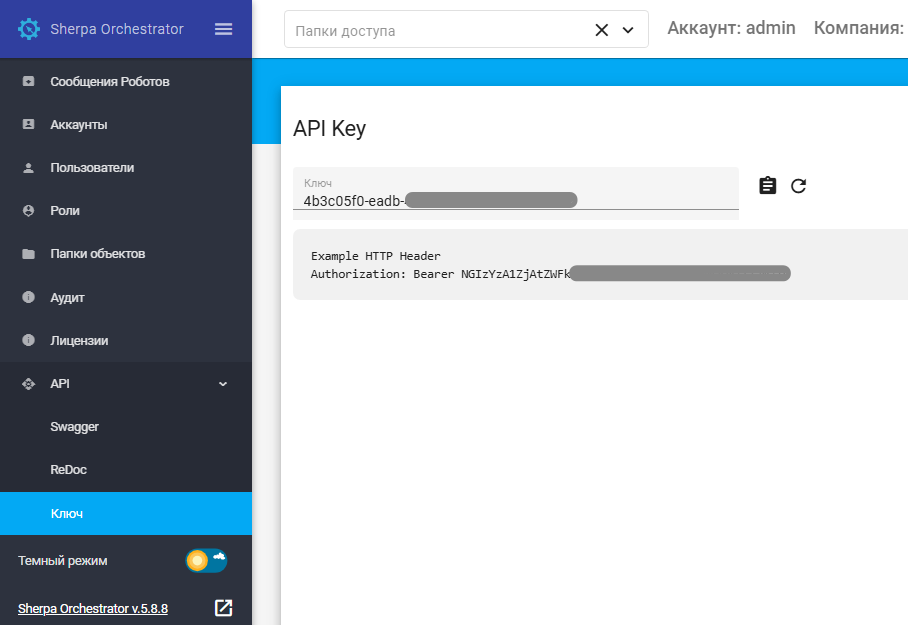
This simplifies working with the API and makes the documentation more convenient for integrations.
- Optimized the "Robot Messages" screen.
The Robot Messages table now opens faster and handles large data volumes, including logs with more than 500 records.
.png)
Previously, when opening or filtering the table, the system had to immediately count the total number of rows in the log, which could cause the page to load slowly or freeze. Now page rows are loaded separately, and the exact number of records is requested by an additional query and displayed after the response is received.
Queries to the log table have become more efficient, and added indexes speed up filtering and pagination.
- On the "Triggers" screen, in the trigger creation or editing window, the display of saved tags after removing tasks from the queue has been fixed.
If a queue is selected in a trigger and the "Consider only tasks tagged with all listed tags simultaneously" field is filled in, the selected tags are displayed as individual labels. These labels are now correctly saved and displayed even after removing associated tasks from the queue.
.png)
This helps avoid losing trigger settings and correctly verifying which tags are involved in task selection.
- On the "Queues" screen, in the task table of the selected queue, the task processing logic has been fixed.
In the Tasks table, users still see task status in the "Status" column, but now a single task is not reserved by multiple workers simultaneously, and the task status is set to .png) only after the worker actually receives it.
only after the worker actually receives it.
This makes task execution in queues more reliable and helps avoid duplicate processing of the same task.
- The "Create partner accounts" field has been removed from the account creation and editing form.
The account form has been simplified: users no longer see the setting that should not be used in the current workflow.
.png)
- Improved stability of API and internal requests.
Fixed handling of input parameters in several API controllers, updated OpenAPI schemas, removed incorrect descriptions of requests to retrieve data without passing a guid, and clarified required fields of input requests.
This makes the API documentation more accurate and integrations with Sherpa Orchestrator more reliable.
- Fixed errors when working with the database and data export.
These fixes affect various Sherpa Orchestrator tables where users can export records, such as Queues or Tasks.
Also improved the search functionality for the "Message" column on the "Robot Messages" screen. Added checks for missing columns, improved column name comparison without case sensitivity, and fixed errors when exporting empty datasets.
This improves the stability of Sherpa Orchestrator on PostgreSQL and MariaDB.
- Fixed errors that could occur when:
- authentication fails,
- deleting an already absent account,
- creating a trigger schedule without an explicitly specified processing type,
- displaying widgets without data.
The system now handles empty or missing values more correctly and does not interrupt operation due to such situations.
- VNC proxy has been moved to a separate Docker Compose profile
vnc.
This change applies to Docker files for Sherpa Orchestrator. The orchestrator-vnc-proxy container now only starts when the VNC profile is explicitly enabled, for example when selecting VNC in the auto-installation script or when running Docker Compose with the vnc profile.
This is convenient for installations where robot VNC connections are not used: unnecessary services do not need to be started, reducing the load on the environment.
- Found container vulnerabilities have been fixed.
Components of container images in which security issues were found have been updated. This improves the security of Sherpa Orchestrator deployment and reduces risks during system operation.